- Europe closed worse than Wall Street, with the Euro Stoxx 50 losing 2.19% and the IBEX 35 falling 1.74% over the week.
- Friday’s PMIs cooled the outlook for the eurozone, while the United States maintained a more resilient macro picture.
- Next week revolves around the Fed, the ECB and major earnings, with oil and interest rates as the real test for valuations.
Análisis fin de semana
Análisis semanal de bolsa: Europa cede y el S&P 500 aguanta
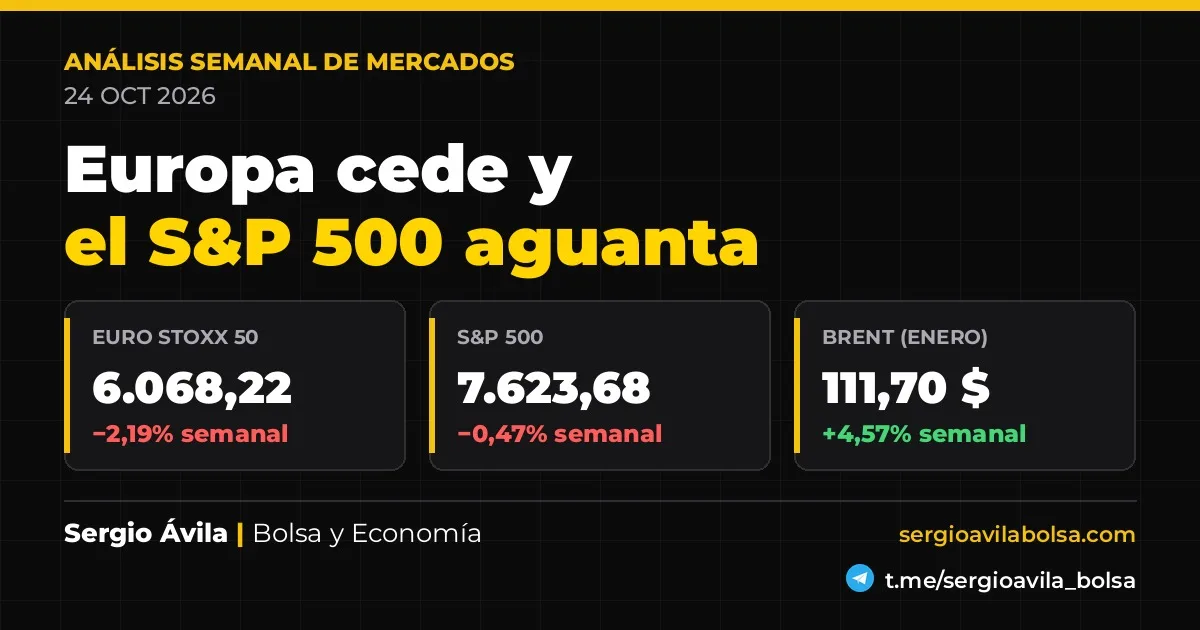
A week of digestion with a weaker Europe and still uncomfortable rates: weekly stock market analysis
My impression of this week is quite simple: the market has not broken, but it has shown where it hurts. In this weekly stock market analysis, the most visible data point is the drop in the Euro Stoxx 50 to 6,068.22 points at Friday’s close on October 23, with a weekly decline of 2.19%, while the S&P 500 ended at 7,623.68 points and limited its pullback to 0.47%. The difference matters: Europe felt the activity slowdown more acutely, and Wall Street held up better, albeit less comfortably.
The backdrop was familiar. Friday’s preliminary PMIs showed cooling services activity in the euro area, just as the U.S. 10-year bond ended at 4.988% and Brent finished the week at 111.70 dollars. High rates and expensive energy are rarely friends of equities; even less so for utilities and consumer stocks, where debt costs and margin pressure weigh more than many would like to admit.
What happened this week
Friday’s closes leave a clear picture
Friday, October 23, closed with uneven damage. The S&P 500 finished at 7,623.68 points, down 0.47% on the week, and the Nasdaq Composite at 25,955.34 points, down 0.71%. In Europe, the punishment was greater: the Euro Stoxx 50 closed at 6,068.22 points, down 2.19% for the week, and the IBEX 35 ended at 18,989.80 points, 1.74% below the previous Friday.
The composition of that decline also leaves some nuance. The IBEX 35 saved Friday with a daily gain of 0.40%, better than other continental indices, but it still could not avoid a down week. To me, that fits a classic reading: banks are still providing a cushion on the rates side, but the index is not immune if caution rises in Europe. Sovereign spreads and future defaults remain the less pleasant part of the banking story, even if the market sometimes prefers to look only at net interest income.
In volatility, the VIX closed Friday at 19.45. It is not a sign of panic, but neither of complacency. The fact that the S&P 500 gave back little with the VIX above 19 suggests a market that is still orderly, although much less robust than it looked when it closed at 7,757.17 points on Wednesday the 21st.
In relative breadth, there is also a useful clue in the comparison between large and small U.S. stocks: this week leadership was not clean. When the S&P 500 only slips slightly, but volatility picks up and the Nasdaq does not clearly lead, the message is not new momentum, but rather selection and fatigue. It is the kind of environment in which it is better to trust price more than the narrative.
The week’s macro data was the slowdown in European PMIs
The data point that most shaped my view did not come from a big inflation headline, but from activity. On Friday the 23rd at 10:00 (2:00 in Mexico City), the euro area preliminary services PMI was published at 51.7 versus 52.6 expected and 53.0 previously. That deterioration came alongside a manufacturing PMI of 52.4, below the 52.7 forecast. It is not recession in the strict sense, but it is a fairly visible loss of traction.
France, moreover, left the most uncomfortable part of the picture. Its preliminary manufacturing PMI came in at 49.3 versus 50.5 expected, and services at 48.4 versus 50.7. Germany offset some of that with manufacturing at 54.2, above 53.5, but its services also softened to 51.7 versus 52.5. In market terms: the bloc is not falling at the same pace, but services weakness matters a lot because that is where part of the recent resilience had been.
In the United States, the picture was less damaged. On Friday the 23rd at 15:45 (7:45 in Mexico City), the preliminary manufacturing PMI came in at 56.0 versus 55.4 expected, while services met expectations at 57.9. At 16:00 (8:00 in Mexico City), the University of Michigan consumer sentiment was revised to 48.0 versus 46.3 expected. Wall Street held up better because macro data did not confirm a sharp slowdown and because the market still accepts growth with high rates, as long as earnings do not wobble.
For Latin America, this stretch matters through two channels. If the Fed maintains a firm tone and the dollar does not ease, external financing remains demanding and assets more sensitive to capital costs feel it first. And if oil also stays high, the effect is not uniform: it helps energy exporters, but it complicates margins and disinflation across much of the region.
Bonds, currencies and commodities: valuation no longer gives anything away
The U.S. 10-year bond closed Friday at 4.988%, slightly above Thursday, though down 2.16% on the week from 5.0980% on Friday the 16th. The level remains high in absolute terms. For equities, that means the discounting of cash flows does not ease much and the more indebted sectors remain under scrutiny. In utilities, the market can tolerate predictable businesses, but it does not usually forgive rising debt costs for long.
In currencies, the euro closed at 1.1204 dollars, essentially flat on the week, down 0.08%. There was no real relief through that channel. A euro with no clear strength and a dollar index at 101.75 leave an environment in which global liquidity does not obviously improve. For Europe, that matters because there is not enough exchange-rate cushion to neutralize the pressure created by elevated energy costs.
Brent (January contract) closed at 111.70 dollars, up 4.57% on the week, and gold ended at 4,007.90 dollars, down 4.14% on the week. That combination is not trivial. Oil kept reminding the market that inflation may be reluctant to fall quickly, while gold corrected despite an uncertain environment, probably weighed more by the level of real rates than supported by safe-haven demand. When the haven does not rise and volatility does not explode, what you usually have is a market that is still disciplined, not necessarily calm.
I am not including an implied P/E and risk premium calculation here because I do not see a recent and valid consensus EPS reference that is worth elevating to a data point. I prefer to omit it rather than fill the gap with a decorative figure. On valuation, I only need one idea: with the 10-year near 5%, equities need solid earnings and not just generous multiples. That bar is reasonable; it is also demanding.
Technical analysis: levels that matter
In the S&P 500, the week leaves a less clean short-term structure after Wednesday’s all-time close at 7,757.17 and Friday’s close at 7,623.68. For me, the key level below is Friday’s low at 7,612.07. If that is broken decisively, the market would confirm that the early-week rebound was a pause and not a new trend leg. Above, immediate resistance lies around 7,757.17, which is the best close of the week and the level that would need to be reclaimed to give buyers back some initiative.
The Murphy reading here is fairly classic: the main trend is still intact if you widen the frame, but short-term momentum has weakened and volatility is picking up. I am not concerned about a correction as long as supports hold; I would be more concerned by a decline with worsening breadth and no earnings reaction. At that point, the tape would shift from digestion to warning.
In the IBEX 35, Friday’s rebound left a close at 18,989.80 after a weekly low at 18,803.60. That low is the first support I am watching. If it holds, the index could continue oscillating within a normal corrective phase after closing Wednesday at 19,323.50. If it gives way, the reading changes and technical deterioration deepens. Above, the immediate reference is again 19,323.50, which was the best close of the week and a visible barrier after the subsequent rejection.
Sector-wise, the index still depends heavily on banks. As long as rates stay high, net interest margins help; but the market does not price that factor at the same multiple if credit and spread concerns grow. In consumer stocks, the problem is more direct: high energy and expensive financing pressure margins. And in utilities, every rise in yields reminds investors that duration also has a bill.
What could move the market next week
Central banks: two dates that really matter
Next week has two clear anchors. The Federal Reserve communicates on Wednesday the 28th at 19:00 (12:00 in Mexico City) and its press conference starts at 19:30 (12:30 in Mexico City). The ECB will do the same on Thursday the 29th at 14:15 (7:15 in Mexico City), with the press conference at 14:45 (7:45 in Mexico City). No need to dress it up: these are the two references that can change the price of money, the dollar and the market’s tolerance for demanding valuations.
My starting bias remains cautious. When the U.S. 10-year is near 5% and energy remains uncomfortable, I find it hard to buy the idea of a quick turn toward cuts or overly soft messaging. If the Fed and ECB insist on higher rates for longer, it would not be a surprise; it would be consistency with the environment. What matters will be whether the market has already priced that in, or whether there is still adjustment pending in duration and capital-cost-sensitive sectors.
On macro, next week’s detailed calendar will be published on Monday in Key Themes of the Week. Without that final schedule, I prefer not to anticipate specific CPI, employment or PMI times and references. The value of the analysis is not in guessing the agenda, but in knowing what would really move assets when it arrives.
Earnings: the stress test runs through technology, banks and consumer stocks
On Wednesday the 28th, after the Wall Street close, Alphabet and Microsoft report. On Thursday the 29th, after the close, Amazon reports. Before that, on Tuesday the 27th, Visa reports after the close and Coca-Cola before the open; on Wednesday the 28th Banco Santander also reports (presentation at 10:00) and on Thursday the 29th BBVA does so (presentation at 9:30). On Friday the 30th, ExxonMobil and Chevron report before the open. There is plenty of market action in that schedule.
For the S&P 500 and the Nasdaq, the week will hinge on a less dramatic question than it may seem: whether earnings support price. In technology, I want to see whether the market still rewards growth with high rates. In consumer stocks, the focus will be on margins and pricing power. In banking, the reading is the usual one, but with less room for complacency: high rates help margins, yes, although the market is increasingly watching credit quality and funding costs.
In Europe, Santander and BBVA will provide a useful clue for the IBEX 35 and the continent’s banking sector. If they maintain a solid revenue picture but show more pressure on provisions or funding costs, the sector could stop acting as the index’s safety net. That would have broader implications, because the IBEX does not need everything to rise in order to hold up, but it does need its heavyweights not to disappoint at the same time.
Geopolitics: oil, inflation and risk premiums
The other focus will remain geopolitical, especially because of its impact on energy and sentiment. With Brent at 111.70 dollars at the weekly close, the market is already saying that risk has not disappeared. The transmission mechanism is direct: high oil complicates disinflation, hardens rate expectations and pressures margins in energy-intensive sectors or those with limited pricing power.
For Europe, that channel is especially relevant. For the United States, the damage is more nuanced because it combines pressure on consumers with relative support for the energy sector. For Latin America, the reading again splits between exporters and importers. And for Asia, it adds noise to a region that already arrives with visible weakness in Japan and Hong Kong this week. No need to dramatize: it is enough to accept that crude remains a central variable, not a second-tier detail.
If I had to rank scenarios, my base case would be a sideways market with a cautious bias, with an indicative probability of 50%, if the Fed and ECB remain firm and earnings are reasonable. I would assign 25% to a more favorable scenario, if big tech beats clearly and central banks do not sharpen their tone. And I reserve 25% for the adverse scenario, if earnings disappoint, yields rebound and oil makes another move higher. It is not a betting slip; it is a way of lining up risk.
My view
I think the week has changed one important thing versus the previous one: Europe has stopped following Wall Street comfortably and has again shown sensitivity to the cycle and the cost of money. To me, that fits a market that is beginning to discriminate more between regions, sectors and balance sheets. I do not see it as a terminal signal, but it is a warning. If the S&P 500 reclaims 7,757.17 and the IBEX 35 moves above 19,323.50 after the Fed meeting on Wednesday the 28th at 19:00 (12:00 in Mexico City) and the ECB meeting on Thursday the 29th at 14:15 (7:15 in Mexico City), I would admit that the market has once again overcome fear. If not, I will continue to read this as a correction that still deserves respect.
What worries me most is a fairly unkind combination: high oil, high rates for longer, and earnings that do not offset valuation demands. Consumer stocks and utilities would suffer especially, and banks would stop being a comfortable refuge if worries about credit or spreads start to surface. As a natural hedge for that scenario, I am still watching liquidity, short duration and energy more than automatic safe havens. Gold fell this week, and it seems to me a good reminder that not every hedge works the same way when the cost of money tightens. The market speaks quite clearly when one bothers to listen.
To go deeper
- My previous analysis: Weekly market analysis: stocks, CPI and oil in focus
- Stock market investing guide — basic concepts to make better decisions
- How to know your risk profile — before trading any asset
Radar Institucional. It brings together context, market breadth and sectors to organize what deserves a more detailed analysis. Learn about Radar Institucional. You can also compare all plans.
This article is general financial information and does not constitute investment advice. Investing involves the risk of loss of the capital invested.
Free community
Register for free access to the community forum
Share analysis, ask questions and connect with other investors — free, in under two minutes.
Create free account